Before You Start: The Real Numbers
What Opening a Restaurant in Southern California Actually Costs in 2026
The most important thing to know before starting this checklist:
undercapitalization is one of the leading causes of restaurant failure.
The SBA consistently cites it as a top reason new restaurants don't make it past year two.
Here are the real ranges from 2026 market data — not the optimistic estimates you'll see on franchise websites.
$175K–$500K+
Full-service restaurant — new build, SoCal market
Median: ~$375K (SuperiorSeating 2026)
$80K–$175K
Second-gen space — existing hood, grease trap, kitchen
Best entry point for first-time SoCal operators
6 months
Working capital reserve recommended before opening day
Source: VantaInsights 2026; NRA guidance
9–12 mo
Typical timeline from concept to opening — new build
4–6 months for second-gen space
10–20%
Contingency buffer to add on top of every estimate
Source: SuperiorSeating 2026 startup guide
$2.95/sqft
Average restaurant rent in Downtown Los Angeles per month
= $5,900/mo for 2,000 sqft (Lightspeed 2025)
Know Your County Before You Sign a Lease
Health Permit Fees & Requirements: LA vs Orange vs Riverside vs San Diego
Permit requirements and fees vary significantly between the four SoCal counties —
and even between cities within the same county. This table covers the key differences
for restaurant operators. Always verify current fees directly with the issuing agency
before budgeting, as these figures are subject to annual adjustment.
| Item |
LA County |
Orange County |
Riverside County |
San Diego County |
| Health Permit — Under 25 seats |
$772/year |
Contact OC EH for current schedule |
County-specific exam required |
County-specific exam required |
| Health Permit — 26–50 seats |
$1,070/year |
Verify with county Environmental Health before budgeting |
| Health Permit — 51+ seats |
$1,472/year |
— |
— |
— |
| Plan Check (new build or remodel) |
Required — 20 business day review; submit floor plans + equipment list + MEP |
Required — timeline varies |
Required |
Required |
| Food Handler Card |
CA statewide — max $15/employee (SB 602) |
$15/employee (state) |
County-specific exam — eliminates state card requirement |
County-specific exam — eliminates state card requirement |
| Business Tax Registration |
City of LA: min ~$100/year (gross receipts based) |
City-by-city |
City-by-city |
City-by-city |
| CDTFA Seller's Permit |
Free — apply at cdtfa.ca.gov — required statewide for any taxable sales |
| ABC Liquor License (if applicable) |
$300–$5,000+ depending on type · 60–90 day processing · requires hearing |
| Conditional Use Permit (CUP) — City of LA |
$5,000–$25,000+ · 3–6 months including public hearing |
City-specific — required for alcohol, late-night, entertainment, drive-through near residential |
| Key contact |
publichealth.lacounty.gov/eh |
ochealthinfo.com |
rivcoeeh.org |
sandiegocounty.gov/deh |
 Self-Order Kiosk
 KDS — EXPO View
Clover Self-Order Kiosk · Kitchen Display System (KDS) — MKR Systems installs free
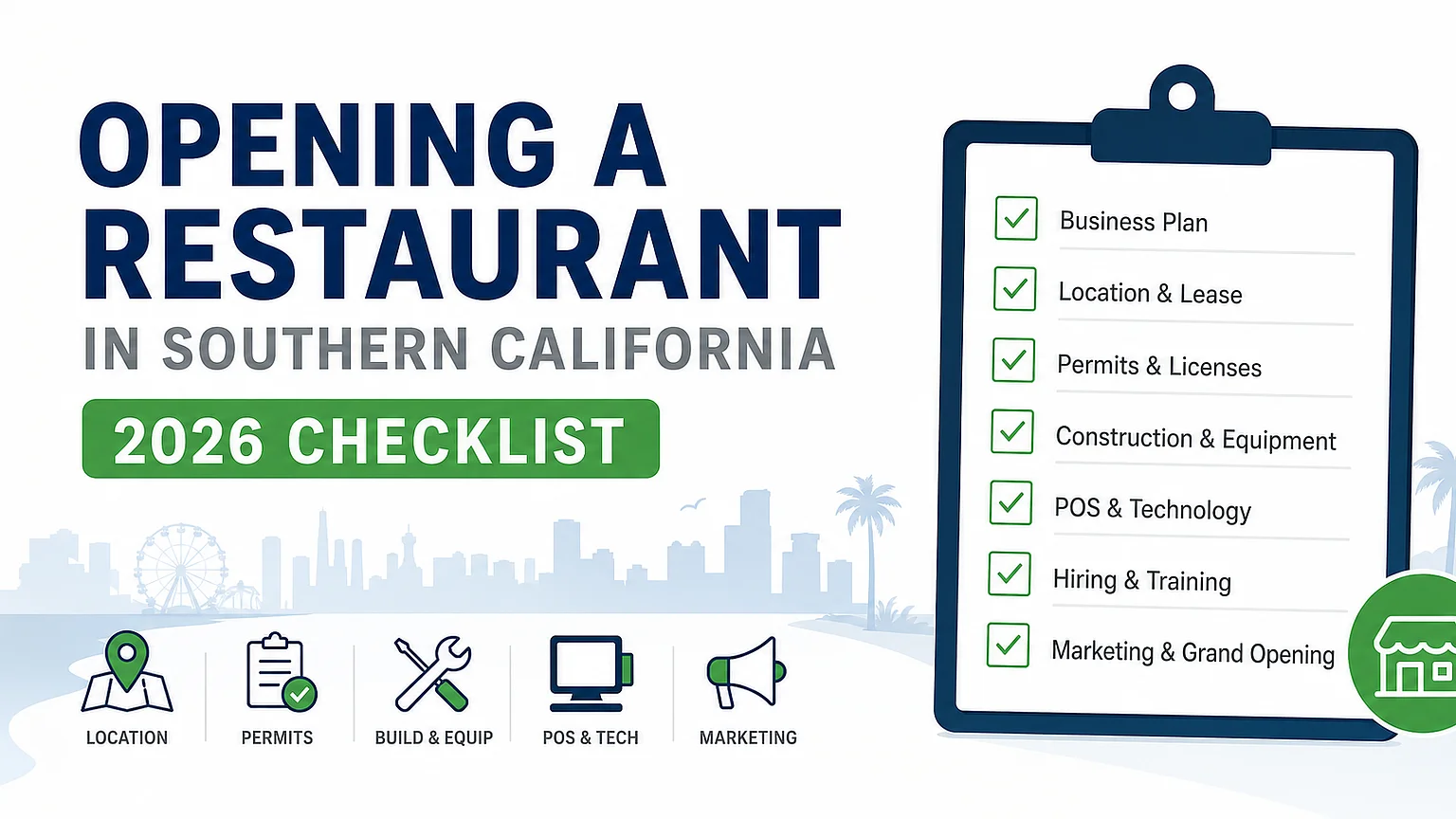
The Master Checklist
Week-by-Week: From Decision Day to Opening Day
Items marked MKR are handled free by MKR Systems
for new restaurant clients. Items marked Critical Path
have long lead times that delay opening if started late.
Start the Critical Path items the same week you sign your lease.
Choose business entity — LLC, S-Corp, or Sole Proprietorship
LLC is the most common for SoCal restaurants. California charges $800/year minimum franchise tax for LLCs — even in year one. Register with CA Secretary of State at bizfile.sos.ca.gov. Note: LLCs formed after Jan 1 are exempt from the $800 tax in their first tax year (AB 85, 2020).
$70–$100
1–5 days online
Obtain EIN (Employer Identification Number)
Free and instant at IRS.gov. Required for business bank account, payroll, and merchant services application. Do this before any other financial setup.
Free
Instant (IRS.gov)
Open business bank account
Bring: EIN, LLC articles of organization, operating agreement, and government ID. Separating business and personal finances is a legal protection AND an IRS requirement once you have employees. Chase, Bank of America, and Chase Bank all have SoCal branches with restaurant owner experience.
Free–$25/mo
Same day
Obtain CDTFA Seller's Permit
California Department of Tax and Fee Administration — required for any business that sells taxable goods including restaurant meals. Free. Apply online at cdtfa.ca.gov. You'll need this before your health permit application in most counties.
Free
1–2 weeks
Verify zoning allows food service at your target location
Contact your city's planning department before signing anything. Some commercial zones require a Conditional Use Permit (CUP) for restaurant use — which can take 3–6 months and cost $5,000–$25,000+ in LA. Don't assume retail zoning = restaurant allowed.
Free
1–3 days
Prioritize second-generation restaurant spaces
A second-gen space — one with an existing Type 1 hood, grease trap, walk-in, and commercial kitchen — can cut your build-out cost by $80,000–$150,000 and your timeline by 3–4 months. Search LoopNet, Crexi, or local commercial RE agents with restaurant experience.
Saves $80K+
Saves 3–4 mo
Negotiate lease with restaurant-specific protections
Minimum: early termination clause, assignment rights (critical if you sell), TI (tenant improvement) allowance, and rent abatement during build-out. Hire a commercial RE attorney — restaurant leases in LA and San Diego have $2.95/sqft average rent. A bad lease clause can sink a profitable restaurant.
$1,500–$3,000 atty
4–8 weeks
Secure financing before signing any lease or vendor agreements
Options: SBA 7(a) loan (up to $5M, long approval), SBA microloan (up to $50K, faster), CDFI loans for minority-owned businesses, or conventional business loans. California SBDC provides free pre-application counseling — sbdcca.org.
$80K–$500K+ need
4–12 weeks
Submit kitchen plans to county Environmental Health for Plan Check
LA County: submit floor plans, equipment list, and MEP schematics. Plan Check review takes 20 business days minimum. This is required before any construction begins. Do not hire a contractor until Plan Check is approved — changes after construction = expensive re-inspection. San Diego DEH has similar requirements; contact dehs.sfdph.org for current forms.
$500–$2,000
20 business days+
Apply for Health Permit (Food Facility Operating Permit)
Filed after Plan Check approval, before construction completion. LA County fees: $772 (under 25 seats), $1,070 (26–50 seats), $1,472 (51+ seats) annually. Riverside and San Diego counties require a county-specific food handler exam — not the state SB 602 exam.
$772–$1,472/yr
2–4 weeks
Schedule and pass pre-opening health inspection
After construction is complete, request the pre-opening inspection from the county health department. You must pass this inspection to receive your Operating Permit. Inspectors check layout, equipment, food storage, handwashing stations, and pest control measures.
Included in permit
Schedule 2 wks out
Obtain building permit for tenant improvements
Required for any construction, plumbing, electrical, or structural work. Your general contractor typically pulls the permit. Ensure ADA compliance (accessible entrance, restrooms, seating) is designed in — retrofitting ADA after construction is extremely expensive.
$2,000–$8,000
2–6 weeks
Fire Department clearance and hood/suppression inspection
LAFD requires fire clearance as part of the Certificate of Occupancy process. Type 1 hoods (for cooking that produces grease) require semi-annual fire suppression certification after opening. Schedule the pre-opening fire inspection at least 2 weeks before your target opening date.
$200–$600
Schedule 2 wks out
Certificate of Occupancy (CO)
Issued by the city building department after passing all inspections (building, fire, health). You cannot legally open to the public without a CO. This is the final gate — all other permits feed into it.
Included in building permit
After all inspections
ABC Liquor License — if serving alcohol
California ABC Type 41 (beer/wine) or Type 47 (full bar). Apply at abc.ca.gov. Processing takes 60–90 days including a public hearing. You cannot legally serve alcohol without this license. Budget $300–$5,000+ depending on license type and location. Start this process the same day you sign your lease.
$300–$5,000+
60–90 days ⚠
Plan network cabling during rough-in phase
The lowest-cost time to run Cat6 cable is during construction when walls are open. MKR Systems consults on cable routing for: POS terminals, KDS kitchen display, security cameras, Wi-Fi access points, and manager office. Running cable after drywall = $300–$800/run extra. Call MKR during your permit phase for a free cabling consultation.
★ Free MKR Consultation
$0 (MKR consult)
During rough-in
Order AT&T Business Internet — 6–8 weeks before opening
AT&T Fiber where available, Internet Air (5G/LTE) where not. Provisioning takes 2–4 weeks. MKR Systems is an AT&T Solution Provider with direct access to the fiber deployment schedule — we know if fiber is available or coming soon at your address before att.com does. Call 888-382-5164 for a free address check.
★ MKR AT&T Solution Provider
Included in $249/mo
Order 6–8 wks out ⚠
AT&T Internet activated + UniFi network installed
MKR configures: UDM Pro router, managed switch, wireless APs. POS VLAN (isolated, PCI-compliant) + Guest Wi-Fi VLAN (rate-limited) + Camera VLAN (local-only). Intrusion Prevention enabled. 5G failover configured — if AT&T drops, backup kicks in in under 5 seconds. Uptime Kuma monitoring on MKR Private Cloud. This is PCI DSS v4.0 compliant from day one.
★ Free Installation
$249/mo
4–6 hrs install
3CX Phone System — Digital Receptionist + Mobile App
Flowroute SIP trunking + 3CX hosted on MKR Private Cloud. Digital Receptionist (IVR), mobile app so staff can take business calls on personal phones, SMS/text from your restaurant number, and time-based routing (lunch rush, after hours, holiday). All for $249/month as part of the MKR bundle.
★ Included in $249/mo
Included in $249/mo
Same day as network
UniFi AI Cameras — Security + Operational Intelligence
G4/G5 Pro cameras for entrance, dining room, kitchen pass, parking lot. People counting for staffing analysis. LPR for delivery accountability. All on a dedicated camera VLAN — completely isolated from POS and guest networks. MKR designs the camera layout during the planning phase at no charge.
★ Free Layout Design
$179+/camera hardware
Same day as network
UPS Battery Backup for network rack
SDG&E and SCE both have Public Safety Power Shutoff (PSPS) programs — intentional power cuts during high fire risk. A UPS keeps your router, switch, and POS running through brief outages. SoCal restaurants on AT&T Fiber with no UPS are vulnerable to short outages that knock out payment processing. Budget $200–$400 for a quality APC or CyberPower UPS. See Week 10 in our blog series for the full ROI math.
$200–$400
One-time purchase
Select Clover hardware — Mini, Station Solo, or Station Duo
For high-volume SoCal QSR or taqueria: Clover Station Duo Gen 2 ($1,899) — dedicated customer-facing screen, built-in NFC for Apple Pay/Google Pay, no add-ons needed. For full-service or moderate volume: Station Solo ($1,799) + Clover Go for NFC. For bar station or secondary: Mini Gen 3 ($799). MKR walks you through the decision free — based on your projected volume and counter setup. See our full hardware comparison guide for the math.
★ Free Hardware Consultation
$799–$1,899 hardware
Order 3–4 wks before opening
MKR Merchant Account Review — Interchange+ vs flat rate
Before boarding your new Clover merchant account, MKR reviews your expected volume and card mix to recommend the right processing structure. Most new SoCal restaurants default to flat-rate pricing (2.3%–2.6%). At $15,000/month volume, Interchange+ pricing saves approximately $127/month — $1,524/year. This review is free. Starting with the right rate structure is far easier than changing it later.
★ Free Rate Review
Saves ~$1,524/yr
Before you sign
Clover installation, menu build, and staff training
MKR arrives before your opening. Network cable run for POS and kitchen devices (KDS or printer). Clover activated with your new MID. Full menu entered — every item, modifier, category, and price — from your menu PDF. Table layout configured. Employee accounts set up. Staff trained at the counter on register, tips, refunds, and shift closeout. Test transactions run. 30-day follow-up included.
★ Free — All Included
Free (with purchase)
Installation day
Set up Clover Online Ordering — commission-free direct orders
Clover Online Ordering is commission-free and integrates directly with your website. Configured during the MKR installation day. Immediately reduces dependency on DoorDash (30.5% effective commission). Even at $3,000/month in online orders, you save $915/month vs DoorDash. See our Week 12 analysis for the full calculation.
Included in Clover plan
Installation day
Workers' Compensation Insurance — required in CA from Day 1 of employment
California requires workers' comp the moment you have one employee. No grace period. Premium varies by payroll and job classification — restaurant line cooks average $3.00–$5.50 per $100 of payroll. Get quotes from at least 3 carriers. State Fund (scif.com) is the CA state option for restaurants that private carriers decline.
~$6,000/yr avg
Before first hire ⚠
EDD New Hire Reporting — required within 20 days of hire
California requires reporting every new hire to CA Employment Development Department within 20 days of their first day. Report at edd.ca.gov/en/payroll_taxes/new_hire_registry. Penalty: $24/unreported hire, $490 if conspiring with employee to not report.
Free
Within 20 days of each hire
Food Handler Cards for all food-contact employees
California SB 602: all food handlers must have a Food Handler Card within 30 days of hire. Max $15/employee for the exam. In Riverside and San Diego counties, a county-specific exam replaces the state card. In LA and OC, the state card is sufficient. Cards must be from an ANAB-accredited program (ServSafe, etc.).
Max $15/employee
Within 30 days of hire
Set minimum wage compliance — CA $16.90/hr as of Jan 1, 2026
California minimum wage is $16.90/hr (2026). Fast food workers: $20/hr (AB 1228). Healthcare workers: $25/hr phased. Exempt employee salary threshold: $70,304/year ($5,858.67/month). Configure Clover time clock and payroll to enforce these thresholds automatically.
$16.90/hr minimum
From Day 1
Set up payroll service — QuickBooks Payroll, Gusto, or ADP
California has among the most complex payroll requirements in the US: overtime calculation (daily OT over 8 hrs, weekly OT over 40 hrs), mandatory paid sick leave (5 days/year), SDI (State Disability Insurance), and tip reporting. A payroll service that knows California law is not optional — it's essential. Integrates with Clover time clock for automatic hours export.
$40–$150/mo
Before first paycheck
Post all required CA labor law notices
California requires specific posters visible to all employees: minimum wage, pay equity, workers' comp, OSHA, CFRA/PDL (family leave), and others. Free poster bundles available at dir.ca.gov. Violation = $100–$1,000 fine per poster. Required to be in English AND in any language spoken by 10%+ of your workforce.
Free (download)
Before first employee
On-site photography session + website build
MKR brings the full mobile photo booth to your location — iPhone 15 Pro, Sony A7 IV, UniFi AI Camera, GoPro, softbox lighting — and shoots your space, food, and team. Then builds your website from those real photos. No stock imagery. 5-week build timeline. See our on-site photography guide for the full process.
★ Full Service
Quoted per project
5-week build
Claim and complete Google Business Profile
business.google.com — fill every field (hours, photos, description, service area). Add 10+ real project photos. This enables map pack visibility for local searches like "tacos near me" or "ramen San Diego." GBP is your highest-visibility free local search real estate and it's completely free. See our GBP guide for the complete setup walkthrough.
Free
2 hours
Register on Yelp, Apple Maps, and Bing Places
Consistent NAP (Name, Address, Phone) across all directories is a core local SEO signal. Complete all three with identical information: "MKR Systems, Inc." format — apply your own restaurant name consistently. Yelp is particularly influential for restaurants in SoCal — a 1-star Yelp increase is correlated with a 5–9% revenue increase (Harvard Business School study).
Free
2 hours total
Set up Google Search Console + submit sitemap
search.google.com/search-console — register your website domain, submit sitemap.xml, and request indexing for all pages. Without this step, Google may not know your website exists for weeks or months. Free, takes 1 hour, and is the single most important SEO action for a new restaurant website.
Free
1 hour
Full Clover POS dry run — all payment types, modifiers, tips, refunds
Run test transactions: chip card, tap/NFC, swipe, and cash. Test every modifier combination on complex menu items. Run a test refund. Run a test tip adjustment. Run shift closeout. The first time your staff sees a problem should be in training — not with a real customer at 12:30pm on a Friday.
Free
2–4 hours
KDS-to-kitchen ticket routing test
Enter a complete order with every modifier type and verify it routes correctly to the right kitchen station. Test KDS order completion and bump. Test what happens when Wi-Fi drops — does KDS reconnect automatically? MKR configures KDS on wired Cat6, not Wi-Fi, precisely to prevent this failure mode.
Free
1 hour
Internet failover test — simulate primary connection drop
Unplug the primary AT&T connection and confirm: (1) UniFi switches to 5G backup in under 5 seconds, (2) Clover POS continues processing, (3) KDS stays connected, (4) 3CX continues taking calls. MKR configures and verifies this during installation. Run the test yourself 1 week before opening to confirm.
Free
30 minutes
Soft opening with invited guests — 1 week before grand opening
Invite friends, family, and trusted community members to a "friends and family" dinner. Charge reduced prices or no charge. The goal is a full service rush simulation — ticket timing, kitchen communication, POS flow, and staff confidence under pressure. Issues found here are fixed before they affect paying customers and online reviews.
Food cost only
1 evening
Post Business Tax Registration Certificate
City of LA and most SoCal cities require the Business Tax Registration Certificate to be posted visibly on the premises. Minimum ~$100/year in LA. Renewed annually based on gross receipts.
~$100/yr min
Opening day
Set up CDTFA sales tax filing calendar
California sales tax is due monthly (if annual liability over $1,000), quarterly, or annually. Set up an automatic reminder. Clover generates a sales tax summary report — export it monthly and reconcile against CDTFA filing. Missing a filing deadline = 10% penalty + interest.
Free (Clover export)
Month 1
Set up accounting software and connect to Clover
QuickBooks Online (best CA restaurant support) connects directly to Clover POS via the QuickBooks Connector app in the Clover App Market. Daily sales, tips, refunds, and taxes sync automatically. Set up Chart of Accounts from day one — reclassifying transactions retroactively at year-end is painful and expensive for your CPA.
$30–$90/mo QuickBooks
Week 1
MKR 30-day follow-up — menu adjustments, system check, processing statement review
MKR Systems follows up at 7 days and 30 days after installation to confirm everything is running correctly — Clover performance, network uptime, 3CX call quality, and first processing statement accuracy. Menu adjustments, employee additions, and any operational changes are handled at no charge in the first 30 days.
★ Included — No Charge
Free
Day 7 + Day 30
The True Cost of Getting the IT Stack Wrong at Opening
Scenario: Restaurant opens with unstable internet + flat-rate processing + no failover
Month 1 processing cost (flat rate 2.6% on $15K volume):
$15,000 × 2.6% + 400 txn × $0.10 = $390 + $40 = $430/month
Month 1 processing cost (MKR Interchange+):
$15,000 × 1.65% + 400 txn × $0.10 = $247.50 + $40 = $287.50 (approx)
Savings: $430 − $287.50 = $142.50/month = $1,710/year
Internet outage cost (3 events × 15 min × $1,670/min at 30% revenue impact):
3 × 15 × $1,670 × 30% = $22,545 annual risk exposure
MKR package cost: $249/month = $2,988/year
Net position vs. doing it wrong:
Processing savings: + $1,710/year
Downtime risk avoided: + $22,545/year (at 30% impact)
MKR package cost: − $2,988/year
Net annual value of MKR IT stack from Day 1: +$21,267 vs. flat-rate + unstable internet
Sources: Nilson Report (avg interchange 1.60–1.75%); ITIC 2024 (micro-SMB downtime $1,670/min); MKR Systems Interchange+ pricing model; AT&T fiber field uptime data
✓ Conservative model — actual savings vary by volume and outage frequency
MKR Systems — Everything Your New Restaurant Needs to Go Live
The Free IT Consultation That Changes Your Opening Timeline
Permit Phase (Month 2–3)
Free Cabling Consultation
MKR advises on Cat6 routes for POS, KDS, cameras, and APs while walls are open. Costs nothing. Saves $300–$800 per cable run later.
6–8 Weeks Before Opening
AT&T Internet Order
MKR checks fiber availability at your address before att.com does. Orders the right service. Confirms install date.
4 Weeks Before Opening
Clover Order + Boarding
Hardware ordered. Merchant account boarding started. Processing rate locked. Free rate review vs. flat-rate alternatives.
Installation Day
Full IT Install — Free
Network cables, UniFi config, Clover activation, full menu build, table layout, staff training — all in one visit. Same day.
Frequently Asked Questions
What First-Time SoCal Restaurant Owners Ask Most
How long does it take to open a restaurant in Los Angeles or San Diego?
Plan for 9–12 months for a new build or gut renovation, or 4–6 months for a second-generation space with an existing commercial kitchen. The longest lead-time items are your ABC liquor license (60–90 days), LA County health permit plan check (20 business days minimum), and Conditional Use Permit if required (3–6 months). Start all Critical Path items the same week you sign your lease. Call MKR Systems at 888-382-5164 for a free consultation on IT timeline planning.
What are the most commonly missed permits for new SoCal restaurants?
Three permits that regularly catch first-time operators off guard: (1) Conditional Use Permit — required for alcohol service, late-night hours, or entertainment in City of LA zones. $5,000–$25,000 and 3–6 months. (2) Signage Permit — any exterior sign, awning, or illuminated display requires a separate permit from the building department. (3) Grease trap installation permit — LA County Sanitation requires a grease trap sized to your kitchen, with cleaning logs maintained. These three alone can add 2–4 months to your timeline if discovered late.
When should I contact MKR Systems during the restaurant opening process?
As early as possible — ideally at the same time you begin your permit applications. The reason: network cabling is cheapest when walls are open during construction. If MKR isn't consulted until after drywall is up, every cable run costs an additional $300–$800. We provide a free cabling consultation during your build-out planning phase. For internet service, order 6–8 weeks before your target opening date — AT&T provisioning takes 2–4 weeks. Call 888-382-5164 for a free new restaurant IT consultation.
Is Clover POS the right choice for a new restaurant in Southern California?
For most independent SoCal restaurants — taquerias, QSR, cafes, full-service dining — Clover is the strongest combination of features, local support, and payment processing flexibility. The key advantages for new restaurants: commission-free online ordering built in, kiosk option for reducing counter labor, Clover Capital funding accessible once you have 3+ months of sales history, and a full App Market for integrations. MKR Systems provides free installation and a free hardware recommendation consultation. Call 888-382-5164.
★ Free IT Consultation · Free Installation · Free Menu Build ★
Opening a Restaurant in SoCal?
Talk to MKR Systems First.
We've done this for dozens of restaurants across LA, OC, Riverside, and San Diego.
One free call gets you a IT timeline, a hardware recommendation,
and an AT&T address check — before you commit to anything.
888-382-5164
Mon–Fri 9AM–6PM PT · MKR Systems · La Mesa, CA 91941
Los Angeles County · Orange County · Riverside County · San Diego County
→ Free New Restaurant Consultation
Book Free Consultation →
The checklist is the easy part. The sequence is everything.
Most first-time SoCal restaurant operators don't fail because they missed a permit —
they fail because they missed the timing of a permit.
Starting your ABC license application two months too late means two months of lost alcohol revenue.
Starting IT planning after drywall means $5,000+ in avoidable cable costs.
Starting with the wrong processing rate means $1,500+ in unnecessary fees every year.
Call MKR Systems at 888-382-5164. The consultation is free.
The information changes your opening plan.
References & Data Sources
- [1]TableLot — California Restaurant Permit & License Checklist 2025 (March 26, 2026) — LA County health permit fees ($772/$1,070/$1,472 by seat count), 20-day Plan Check timeline, LAFD requirements, CUP fees and timeline, City of LA Business Tax Registration. tablelot.com
- [2]CloudKitchens — Food Licenses & Permits California: The 2026 Guide — SB 602 food handler card max $15/employee. Riverside and San Diego county-specific exam requirement. Health permit costs $320–$2,000 range. cloudkitchens.com
- [3]RestaurantLaunchpad.io — How Much Does It Cost to Open a Restaurant? (April 2026) — Updated April 20, 2026. Ghost kitchen $48K–$159K. Full-service $175K–$500K+. Build-out represents 35–50% of total startup cost. restaurantlaunchpad.io
- [4]SuperiorSeating — How to Open a Restaurant in 2026: Costs, Steps & Full Startup Guide (1 month ago) — Median startup cost ~$375,500 full-service, ~$225,500 limited-service. 10–20% contingency recommendation. "Budget separately for 3–6 months working capital before you open." superiorseating.com
- [5]VantaInsights — Restaurant Startup Costs 2026 (March 5, 2026) — Median independent restaurant startup $275K–$425K. Second-gen space $80K–$150K. Working capital: reserve minimum 90 days of fixed costs. BLS QCEW restaurant wage data. vantainsights.com
- [6]CulinaryIncubator.com — Los Angeles Restaurant Health Permit Guide 2026 (January 15, 2026) — LA County DPH Plan Check process, pre-opening inspection requirement, LAFD fire clearance, Certificate of Occupancy process, CUP requirements. culinaryincubator.com
- [7]RestoLabs — California Licenses and Permits to Open a Restaurant 2026 — ABC license 60–90 day processing timeline, $300–$5,000+ cost range. Food safety certification $15–$50/employee. CDTFA free application. restolabs.com
- [8]Lightspeed — Restaurant Startup Costs (October 2025) — Downtown Los Angeles average restaurant rent $2.95/sqft = $5,900/month for 2,000 sqft. Deposit: $17,700–$35,400. lightspeedhq.com
- [9]ITIC 2024 Hourly Cost of Downtime Survey — Micro-SMB (fewer than 25 employees) downtime cost approximately $1,670 per minute. Consistently cited across multiple posts in this series.
- [10]California ABC — Liquor License Application — License types, fees, processing timelines, and hearing requirements. abc.ca.gov/licensing
- [11]California DIR — Labor Law Posting Requirements — Required postings, languages, and civil penalty amounts per poster. dir.ca.gov
MKR Systems, Inc. is an authorized Fiserv / Clover reseller and AT&T Business agent serving Los Angeles, Orange, Riverside, and San Diego counties. This checklist is provided for informational purposes and reflects conditions as of May 2026. Permit fees, timelines, and requirements change frequently — always verify current requirements directly with the issuing agency before budgeting or making commitments. This article does not constitute legal, financial, or tax advice. Consult a licensed attorney, CPA, and licensed contractor for your specific situation. MKR Systems provides free IT consultation and Clover POS installation for qualifying new restaurant clients. Free installation is provided at MKR Systems' discretion upon new Clover system purchase and processing agreement with Fiserv / CardConnect.