Payment Savings
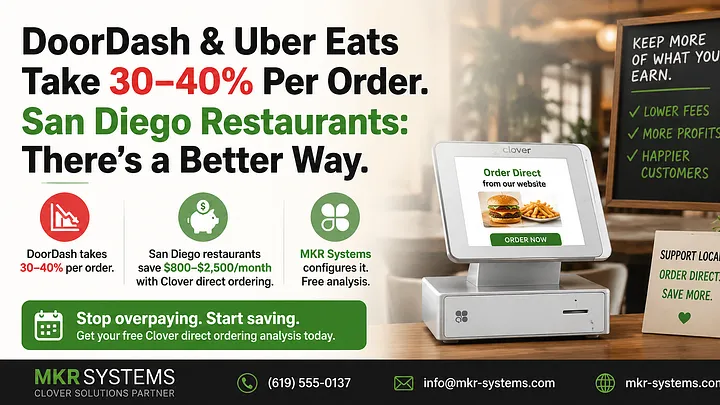
DoorDash & Uber Eats Take 30–40% Per Order. San Diego Restaurants: There's a Better Way.
DoorDash takes 30–40% per order. San Diego restaurants save $800–$2,500/month with Clover direct ordering. MKR System...
Most business owners don't overpay because they're careless — they overpay because these statements are designed to be confusing. Here's what actually matters.
Most merchants never verify if their fees are correct — and processors count on that.
The Core Problem
Every month your business processes payments. Every month fees are deducted. Rates change, hidden fees appear, and pricing structures shift — often quietly, without notice. By the time you notice, months of overcharges have already cleared.
What to Look For
Set by Visa, Mastercard, and other card networks. Based on card type, transaction method, and risk level. Usually the largest portion of your total fees.
Non-negotiableAlso set by card brands. Small percentage applied to total transaction volume. Think of this as the "network access fee" — you can't avoid it.
Non-negotiableThis is where things get unclear. Processors bundle fees, rename line items, add "service" or "program" charges, and quietly increase margins over time.
You can control thisMost statements intentionally blur the line between what is fixed (interchange, assessments) and what is variable (markup). That's why two businesses with identical volume can pay very different fees.
Pricing Structures
Flat rate. Simple — but often significantly more expensive. Common with Square, Toast, and most consumer processors. Easy to understand, hard to optimize.
Interchange+ pricing. Transparent. You pay actual network cost plus a fixed margin. Scales efficiently with volume and is auditable line by line.
Ongoing Vigilance
MKR Systems Perspective
Even on our side, pricing environments change. That's why we built a system around continuous statement auditing — not just a one-time review at onboarding. We actively monitor and work to maintain our pricing promise over time.
Upload your statement. We'll break it down in plain English.
Most merchants find savings within 24 hours.
MKR Systems
One local partner for Southern California restaurants & retailers.