cloverpos.io detects your approximate region from your IP
address to show local pricing and promotions, and stores your
choice in a cookie so you stay on the right page. You can change
your region anytime from the header. No tracking for advertising.
Privacy Policy
Payment Savings
May 29, 2026
· Southern California
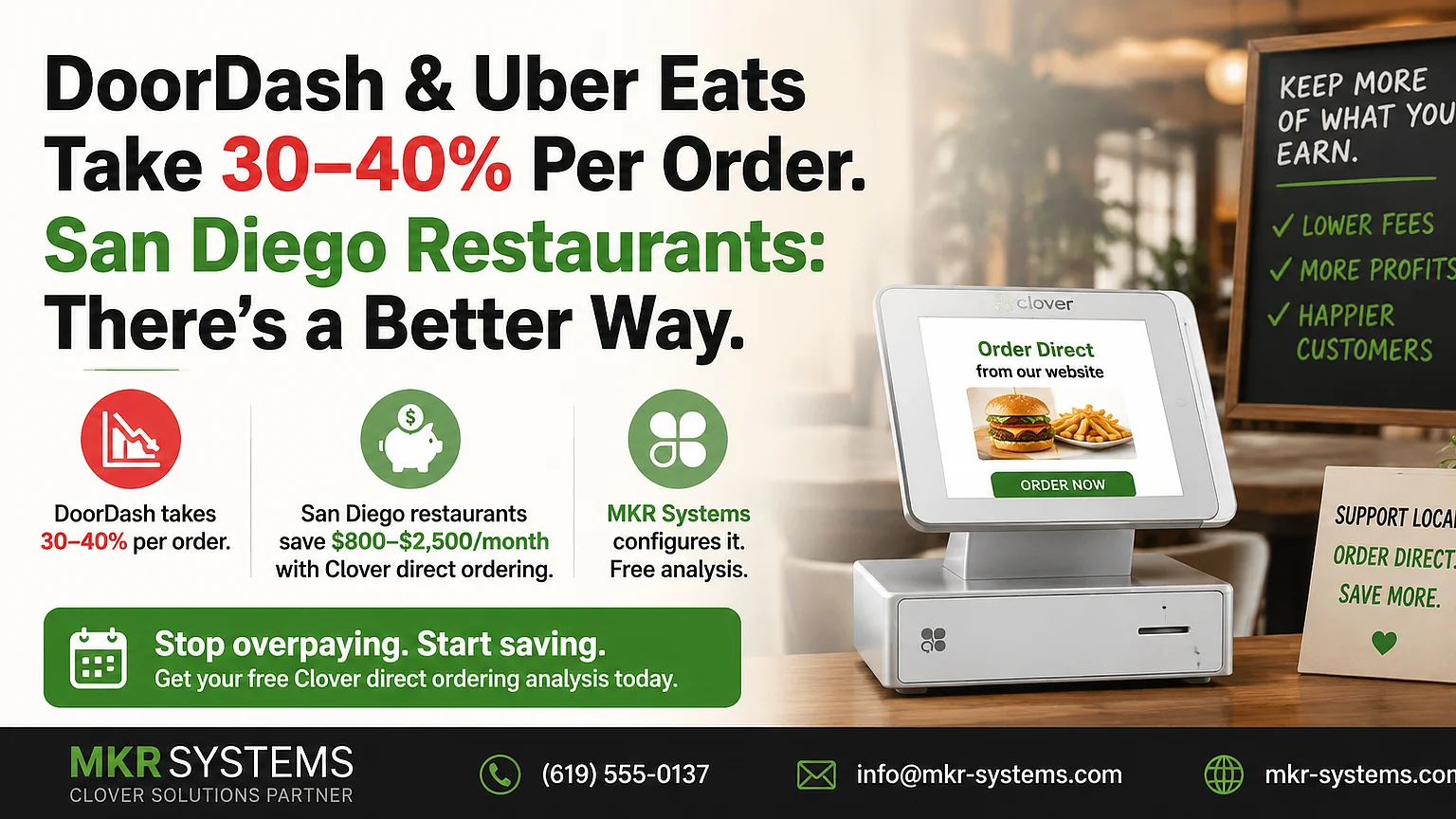
DoorDash & Uber Eats Take 30–40% Per Order. San Diego Restaurants: There's a Better Way.
DoorDash takes 30–40% per order. San Diego restaurants save $800–$2,500/month with Clover direct ordering. MKR Systems configures it. Free analysis.
★ Free Consultation · 888-382-5164 · Los Angeles · Orange · Riverside · San Diego
DoorDash and Uber Eats commissions don't just cost 15–30%. When processing fees, promotions, and chargebacks are included, the real cost reaches 30–40% of every order.
What You're Actually Paying
Third-party delivery platforms have a simple pitch: more customers, more orders. What they don't advertise
is the full cost structure. Most restaurant owners see the headline commission rate and underestimate what
they're actually paying per order. The 2026 data is now clear — and it's worse than most assume.
15–30%
headline commission rate per delivery order (DoorDash / Uber Eats tiers)
Source: Platform pricing pages, 2026
30–40%
actual effective cost per order once processing fees, promos, and chargebacks are included
Source: Rezku POS Industry Report 2026 (restaurant operator survey)
30–70%
savings per comparable order when switching from marketplace to first-party delivery
Source: Incentivio restaurant operations data
43%
of customers can't recall the restaurant name after ordering through a delivery app
Source: Digital Restaurant Association research
Platform Fee Breakdown
What Each Platform Actually Charges in 2026
DoorDash
15 / 25 / 30%
Basic / Plus / Premier delivery tiers. 6% pickup across all plans. #1 US market share at ~67% of delivery sales. Premier includes growth guarantee of 20 orders/month but highest commission rate.
67% US market share
Uber Eats
15 / 25 / 30%
Lite / Plus / Premium tiers. 6% pickup. Webshop (first-party) at 2.5% + $0.29. Second in US at ~23% share. Increasingly pushing paid visibility and promotion add-ons that raise effective cost.
23% US market share
Grubhub
5–10% + delivery
Marketing commission plus separate order processing and delivery fees. Now owned by Wonder Group. Lower headline rate but advertising add-ons are common. Trailing on market share vs. DoorDash/Uber.
Lower headline rate
💸
The Hidden Cost Stack on Every Order
Beyond the headline commission: payment processing fees (2.9–3.5%), chargeback absorption, menu price suppression pressure, paid visibility promotions, and customer data that belongs to the platform — not you. A restaurant with a 10–15% profit margin cannot absorb a 30% commission and remain profitable on delivery without significant menu price inflation on those channels.
The Clover Strategy
Using Clover Online Ordering to Shift Revenue Back
Third-Party Marketplace Order
−30 to −40%
Commission + processing + promotions + chargebacks. Customer data owned by platform. 43% of customers won't remember your name. Useful for discovery — expensive for repeat business.
Clover Direct Online Order
~2–3% processing only
Commission-free. Customer data is yours. Orders route directly to Clover and KDS. Delivery fulfillment via DoorDash Drive or Uber Direct at flat per-delivery rate — no marketplace commission. You own the relationship.
✓
Use marketplace for discovery — New customers finding you on DoorDash or Uber Eats is a legitimate customer acquisition channel. The commission is the acquisition cost.
✓
Convert repeat customers to direct — Include a "Order direct next time" card in every delivery bag. Offer a discount for first direct order. Repeat customers are where margins live.
✓
Set menu prices by channel — Many restaurants charge 10–15% more on delivery platforms to offset commissions while keeping in-house prices unchanged. Platforms allow this.
✓
Use DoorDash Drive / Uber Direct for fulfillment — These DaaS (Delivery as a Service) products let you take first-party orders through Clover and fulfill them with marketplace drivers at flat per-delivery rates — no commission.
✓
Measure contribution margin by channel — Tracking revenue by channel is straightforward in Clover. Compare effective margin on marketplace vs. direct orders monthly. The shift becomes quantifiable.
MKR Systems Approach
We configure Clover Online Ordering and delivery integration as a complete workflow — from order to kitchen to door.
Clover's direct online ordering, KDS routing, and DaaS delivery integration are configured together.
The setup takes 2–3 hours. The margin recovery begins on the first direct order.
Most restaurants see meaningful contribution margin improvement within 60–90 days of shifting repeat orders to direct.
📐 Mathematical Verification
DoorDash Effective Cost Rate — Plus Plan Verification
Base commission = 25%Payment processing fee = 2.9% + $0.30/orderMarketing/promotions = ~2% (industry average estimate)Effective cost on a $50 order: Commission = $50 × 25% = $12.50 Payment fee = $50 × 2.9% + $0.30 = $1.75 Promotions = $50 × 2% = $1.00 Total = $15.25= Effective rate = $15.25 ÷ $50 = 30.5% — validates the "30–40%" range stated in the article ✓
Marketplace delivery is a customer acquisition channel — not a profit channel.
Use it strategically for discovery. Systematically convert repeat customers to direct ordering.
The math is straightforward: shifting 30% of repeat orders to direct typically recovers
$800–$2,500/month for a mid-volume restaurant.
That's the model. Configuration is the only step.
[1]DoorDash for Merchants — Pricing — Official 2026 commission tier structure: Basic 15%, Plus 25%, Premier 30%. Pickup 6% across all plans. merchants.doordash.com/en-us/pricing
[2]Uber Eats for Restaurants — Pricing — Official 2026 tier structure: Lite 15%, Plus 25%, Premium 30%. Uber Direct flat-fee DaaS. restaurants.ubereats.com/pricing
[3]Rezku POS Industry Report 2026 — Restaurant operator survey: effective delivery cost 30–40% inclusive of processing, chargebacks, promotions. www.rezku.com
[4]Incentivio Restaurant Operations Data — First-party vs. third-party delivery margin analysis across 200+ restaurant clients. www.incentivio.com
[5]Digital Restaurant Association — Consumer brand recall study: 43% of customers cannot name the restaurant after marketplace delivery. www.digitalrestaurant.org
[6]CloudKitchens 2026 Operator Guide — 30–70% cost savings documented when shifting from marketplace to first-party delivery. cloudkitchens.com
MKR Systems is an authorized Fiserv / Clover reseller and AT&T Business agent. All analysis, recommendations, and cost models in this article are independently produced by MKR Systems based on publicly available data and our direct operational experience. Third-party data sources are cited as listed above. MKR Systems is not affiliated with, endorsed by, or acting on behalf of Fiserv, Clover, Ubiquiti, 3CX, or any other vendor mentioned herein for the purposes of this publication.
FAQ
Delivery commissions — quick answers
How much do DoorDash and Uber Eats actually take?
Marketplace commissions typically run 15–30% per order depending on plan tier — on a $40 order that's $6–$12 gone before food cost.
Can I take online orders without paying commissions?
Yes. Clover Online Ordering embeds commission-free ordering on your own website, so repeat customers order direct. MKR sets it up as part of a connected POS + website system.
Should I drop the delivery apps entirely?
Usually no — treat marketplaces as paid customer acquisition, then move repeat customers to your commission-free direct channel. That's where the margin comes back.
MKR Systems
One local partner for Southern California restaurants & retailers.