MKR Systems
Written by the MKR Systems team — San Diego IT infrastructure, Clover POS, and payment optimization specialists. Serving restaurants and retail businesses across San Diego, Los Angeles, Phoenix, and Las Vegas.
Through 2025, 80% of businesses absorbed tariff costs directly. In 2026, those costs began passing through to consumers — and your business is no exception.
The Structure of 2026 Inflation
2026 inflation is different from the pandemic era. This time, tariffs, shipping disruptions from Middle East
conflict, rising US minimum wages, and a weaker dollar are all acting at once.
According to JPMorgan analysis, about 80% of the tariff costs businesses had been absorbing through 2025
are passing into consumer prices in 2026.
+0.3pp
Goldman Sachs: forecast additional inflation from tariffs in H1 2026 (on top of +0.5pp the prior year)
Source: Goldman Sachs, Dec 2025 note
51%
Share of supply-chain leaders who passed higher costs through to consumer prices (Jan 2026 survey)
Source: Relex State of the Supply Chain 2026 (n=514)
16%
Average US consumer price increase on 2018–2019 tariff-affected goods — the 2026 scale is larger
Source: NBER Working Paper (Cavallo et al. 2021)
18%
Share of businesses that restructured their supply chain or delayed investment — hitting small operators disproportionately
Source: Relex Supply Chain Survey 2026
The Hit to Small Businesses
Four Cost Pressures Facing Restaurants & Retail
Pressure 01 / Food Cost
Rising ingredient & food costs
25% tariffs on agricultural imports from Mexico and Canada. Direct hit to olive oil, canned goods, imported meats, and more. Thin-margin menu items are the first to fall below break-even.
Direct hit
Pressure 02 / Equipment
Higher equipment & supply costs
Tariffs of up to 145% (currently being adjusted) on Chinese kitchen equipment, electronics, and packaging. Prices rise on POS peripherals, printer paper, and packaging boxes. Inventory-stocking costs go up too.
Indirect hit
Pressure 03 / Labor
Rising labor costs (CA minimum wage)
California minimum wage $16.90, some cities $17.50–$19.50+. Fast-food chains $20.00. For 10 full-time employees, that's about $8,320 in added annual labor cost (+$693/month).
CA-specific factor
Pressure 04 / Freight
Higher logistics & shipping costs
Middle East conflict reroutes Red Sea shipping → Asia–Americas transit times grow by weeks and costs rise. Delivery uncertainty forces earlier inventory buys → cash-flow strain.
Global factor
🧮
Quick cost-shock calculation
Monthly ingredient cost × 8–12% = your estimated added cost in 2026 (combined tariff + freight effect). Example: $8,000/month in ingredients → $640–$960/month in added cost. If that amount isn't recovered through menu pricing or operating efficiency, your margin drops by the same amount.
Step-by-Step Action Plan
Step-by-Step: 8 Actions to Take Now
-
1
Do now — this week
Understand your cost structure (COGS analysis)
Pull the last 3 months of sales and cost data from Clover reports. Calculate Food Cost % per menu item. Flag items over 30% cost ratio for review first.
-
2
Do now — this week
Review supplier contracts and negotiate price locks
Contact your key ingredient and supply vendors. Negotiate whether a 6–12 month price lock is possible. Confirm bulk-purchase discounts and prepay options.
-
3
Within 2 weeks
Menu engineering: adjust or remove high-cost items
Analyze every menu item into four groups: Stars / Plowhorses / Puzzles / Dogs. Remove high-cost, low-popularity items (Dogs). For high-cost, high-popularity items (Plowhorses), raise prices 5–8% or adjust portions.
-
4
Within 2 weeks
Separate delivery-app menu prices from in-store prices
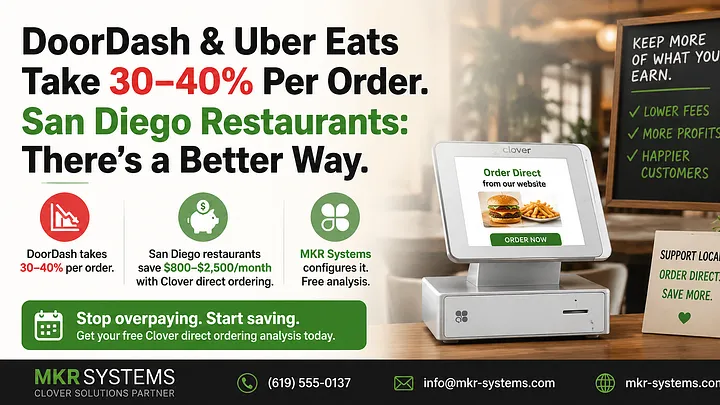
DoorDash and Uber Eats channels already carry 15–30% commissions that must be reflected. Raising delivery menu prices 10–15% is an industry standard. Build a direct-order channel through Clover Online Ordering in parallel to recover margin.
-
5
Within 1 month
Secure two or more alternate suppliers
Relying on a single supplier leaves you exposed to tariff and logistics shocks. Build a backup-vendor list that can replace your current key suppliers. Evaluate not just price but delivery reliability, minimum order quantities, and credit terms.
-
6
Within 1 month
Improve labor efficiency with kiosk or mobile ordering
The most direct response to rising labor costs. A Clover Kiosk handles the order volume of one counter employee while also lifting AOV (average order value) by 10–30%. Payback period of 30–90 days.
-
7
Repeat quarterly
Build a cash-flow buffer (target 90 days of operating costs)
Tariff and price shocks are unpredictable. Target keeping 90 days of fixed costs in a separate account. Apply proactively for an SBA 7(a) line of credit — terms are more favorable applying now than after a crisis.
-
8
Ongoing monitoring
Audit card fees and payment costs regularly
When prices rise, payment-processing costs rise proportionally (since fees are %-based). Check your Effective Rate monthly. Switching to an Interchange+ pricing structure can save hundreds to thousands of dollars per month.
🎯
Priority: where to start first
Fastest impact: menu price adjustments (immediate) → separate delivery-channel pricing (1–2 weeks) → supplier negotiation (2–4 weeks). Biggest long-term impact: adding a kiosk + strengthening direct-order channels. Running both tracks in parallel is ideal.
Retail vs. Restaurant-Specific Responses
Additional Action Points by Business Type
- R
[Restaurant] Implement a portion-control system — cutting ingredient waste 10–15% feeds directly into your cost ratio. Write standard recipe cards, stock measuring tools, train staff.
- R
[Restaurant] Increase the share of seasonal & local ingredients — replace some import-dependent ingredients with domestic/local sources. Blocks tariff impact + creates a marketing angle (Farm-to-Table story).
- T
[Retail] Optimize inventory turnover — re-examine ordering cycles for tariff-affected products. Calculate the trade-off between locking in prices with early orders vs. inventory-holding cost.
- T
[Retail] Customer communication strategy when raising prices — frame it as "an adjustment to maintain quality" rather than a bare price-increase notice. Give loyal customers advance notice of increases plus a thank-you promotion.
- ✓
[Both] Negotiate utility costs and invest in energy efficiency — use SDG&E commercial energy-efficiency programs. LED swaps and refrigeration upgrades have a 2–3 year payback.
- ✓
[Both] Optimize card-payment costs by channel — switching to an Interchange+ structure reduces the cost of processing delivery-app orders. Consider adopting a cash-discount program.
The MKR Systems View
Infrastructure efficiency is the most sustainable way to respond to inflation.
Cut labor cost with a kiosk, cut delivery commissions with Clover direct ordering, cut payment cost by switching to Interchange+ —
configuring just these three well can deliver $1,500–$4,000/month in savings.
When prices rise, operating efficiency is your strongest line of defense.
📐 Math Verification
Tariff cost-shock simulation
Basis: $8,000/month in ingredient cost
$8,000 × 8% = $640/month (conservative)
$8,000 × 12% = $960/month (midpoint)
$8,000 × 16% = $1,280/month (NBER measured max)
= Expected range $640–$1,280/month ✓
Source: NBER Tariff Passthrough Study; Goldman Sachs Dec 2025; KPMG 2026 Global Trade Outlook
✓ Verified
Margin recovery from a 5–8% menu price increase
Assume: $30,000/month revenue, current ingredient cost ratio 32%
Cost increase: $9,600 × 10% = $960/month added
Scenario A (5% increase): added revenue $1,500 → net effect +$540/month
Scenario B (8% increase): added revenue $2,400 → net effect +$1,440/month
= A 5–8% increase fully offsets the cost shock + adds $540–$1,440/month in margin ✓
Source: MKR Systems internal model (assumes $30,000/month revenue, 32% ingredient cost ratio)
✓ Verified
Combined monthly effect of the three savings strategies
① Kiosk — labor savings: $18/hr × 4hr/day × 25 days = $1,800/month
② Clover direct ordering — commission savings: $8,000 × 30% × 27% = $648/month
③ Interchange+ switch: $30,000 × (2.6% - 1.8%) = $240/month
Total: $1,800 + $648 + $240
= $2,688/month ($32,256/year) ✓
Source: Nanonation white paper; Incentivio restaurant data; MKR Systems Interchange+ performance data
✓ Verified
Verifying the Goldman Sachs inflation forecast figures
2025 tariff impact: +0.5pp (actual)
H1 2026 additional forecast: +0.3pp → 2026 estimate ~3.0%
Restaurant ingredients rise faster than CPI (historically 1.5–2×)
= The 8–12% ingredient-cost increase estimate is conservative — actual range could be 6–16% ✓
Source: Goldman Sachs Dec 2025; Fed Powell statement; KPMG 2026; NBER
✓ Verified
Free Operating-Cost Reduction Analysis
Kiosk ROI, delivery-commission savings, payment-cost optimization — calculated from your own data.
→ Call 888-382-5164
↓ Learn More
Tariffs and inflation are external forces. But the way you respond is internal.
Adjusting menu prices, optimizing fees by channel, cutting labor cost with a kiosk, diversifying your supply chain —
these are all things you can act on now.
The first step of the action plan is to open your COGS today.
References & Data Sources
- [1]Goldman Sachs Economic Research — December 2025 note: tariffs caused +0.5pp inflation in 2025; +0.3pp forecast for H1 2026.
- [2]KPMG — 2026 Global Trade Outlook — Analysis of tariff policy impact on supply chains and domestic price levels. kpmg.com
- [3]Relex — State of the Supply Chain 2026 — January 2026 survey, n=514 retail/manufacturing/supply chain leaders. 51% raised consumer prices. relex.com
- [4]NBER — Tariff Passthrough Study (Cavallo et al.) — 16% average price increase on tariff-affected goods during 2018–2019 US trade war. nber.org
- [5]JPMorgan — Tariff Cost Pass-Through Analysis — 2026: businesses shifting ~80% of tariff costs to consumers.
- [6]Federal Reserve — Jerome Powell Statement — Tariffs responsible for inflation above 2% target; 2025 CPI ended at 2.7%. federalreserve.gov
MKR Systems is an authorized Fiserv / Clover reseller and AT&T Business agent. All analysis, recommendations, and cost models in this article are independently produced by MKR Systems based on publicly available data and our direct operational experience.