Website & Marketing
How to Get Your SoCal Business Blog Found on Google
Great content in an unindexed site gets zero traffic. MKR Systems shows SoCal restaurants the exact 9-step order to g...
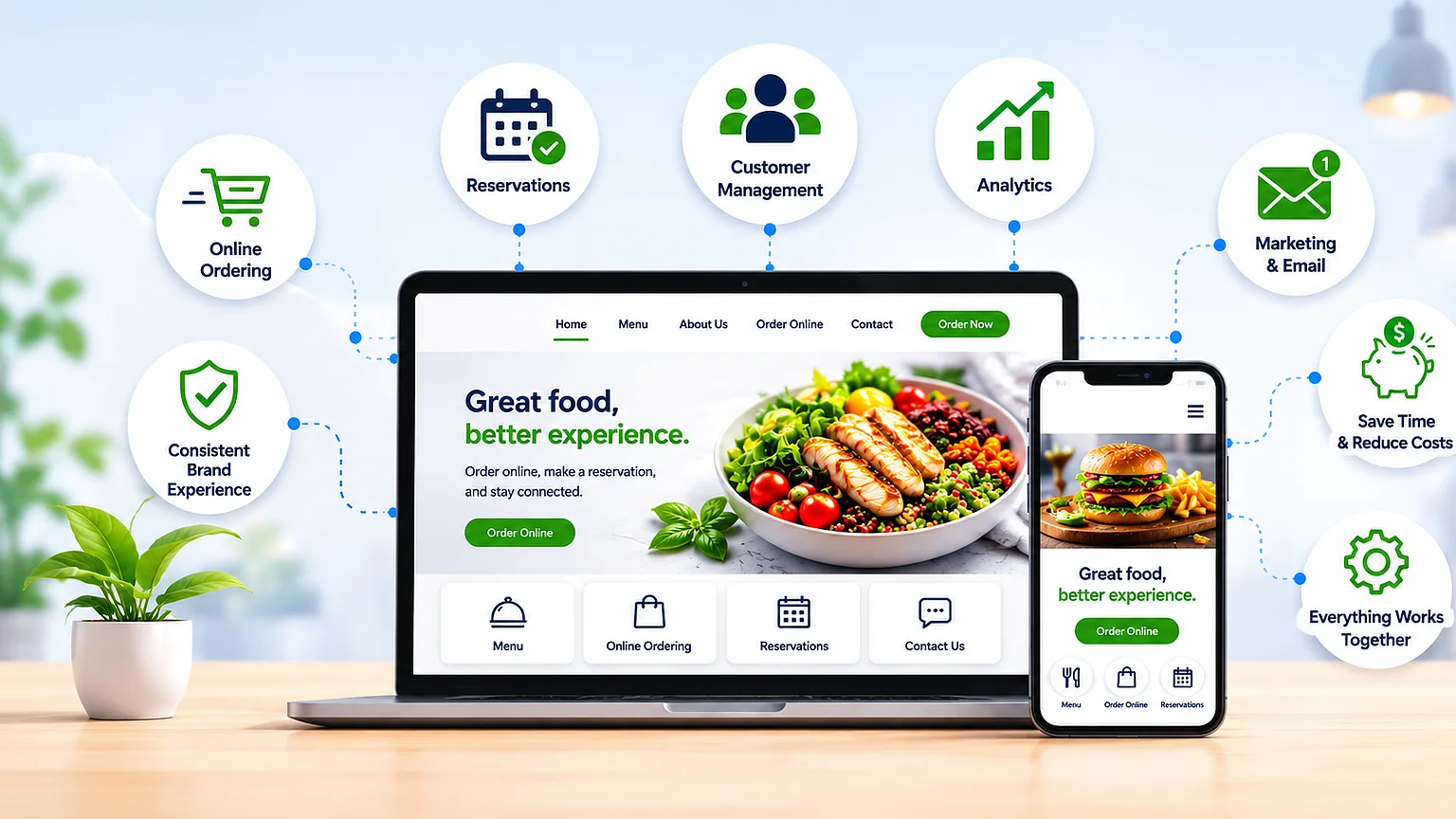
Not a pile of separate tools. Not five subscriptions duct-taped together. Here's what a real, integrated business website looks like — and why it matters for operations.
A pile of separate tools isn't a website system — it's a maintenance job that grows every year.
The Toolstack Problem
Most small business websites are assembled from disconnected pieces: a CMS here, a booking tool there, a payment processor from one vendor, email from another, analytics from a third. Each tool works in isolation. None of them talk to each other without custom integrations — which break silently.
What Fragmented Looks Like
WordPress + plugin for bookings + Stripe manually embedded + Mailchimp for email + Google Analytics + Square for POS + Zapier to connect them. Each has its own login, billing cycle, update cadence, and failure mode.
Rails 8 application with content, orders, customer records, email, and analytics in a single database. One deployment. One update cycle. Data flows between features by design — not by integration.
Every connection between separate tools is a liability. When Zapier changes an API, your bookings stop syncing. When WordPress updates a plugin, your checkout breaks. The integration tax compounds over time — more tools means more maintenance, more failure points, and more hours spent fixing things that weren't broken last month.
What Integration Actually Means
Blog posts, landing pages, service descriptions — all managed in the same system as your customer records and orders. No separate CMS login. No content that exists outside your database.
Spina CMSOnline ordering, subscription billing, or ecommerce — connected to your customer and content data natively. Order history is visible in the same admin as your CMS entries.
Solidus / StripeForm submissions, inquiry leads, and customer records in the same database as everything else. No Zapier required to get a contact form submission into your CRM.
Built-inAvo Admin gives you a full back-office interface — orders, customers, content, and settings — without building a custom admin from scratch. One login for everything.
Avo AdminMKR Systems Approach
Spina CMS for content management. Solidus for ecommerce. Avo Admin for back-office. Devise for authentication. Deployed on MKR Private Cloud — not on shared hosting that throttles under load. One codebase, one database, one team responsible for the whole thing.
We'll assess your current stack and map out what an integrated system would look like for your business.
☎️ Call 888-382-5164 Get My Free Statement Audit →MKR Systems, Inc. is an authorized Fiserv / Clover reseller and AT&T Business agent serving Los Angeles, Orange, Riverside, and San Diego counties. All analysis, recommendations, and cost models in this article are independently produced by MKR Systems based on publicly available data and our direct operational experience. Pricing and product specifications are current as of publication date and subject to change.
MKR Systems
One local partner for Southern California restaurants & retailers.