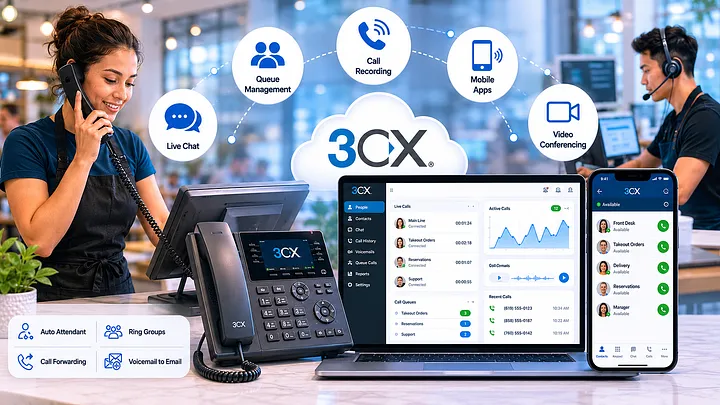
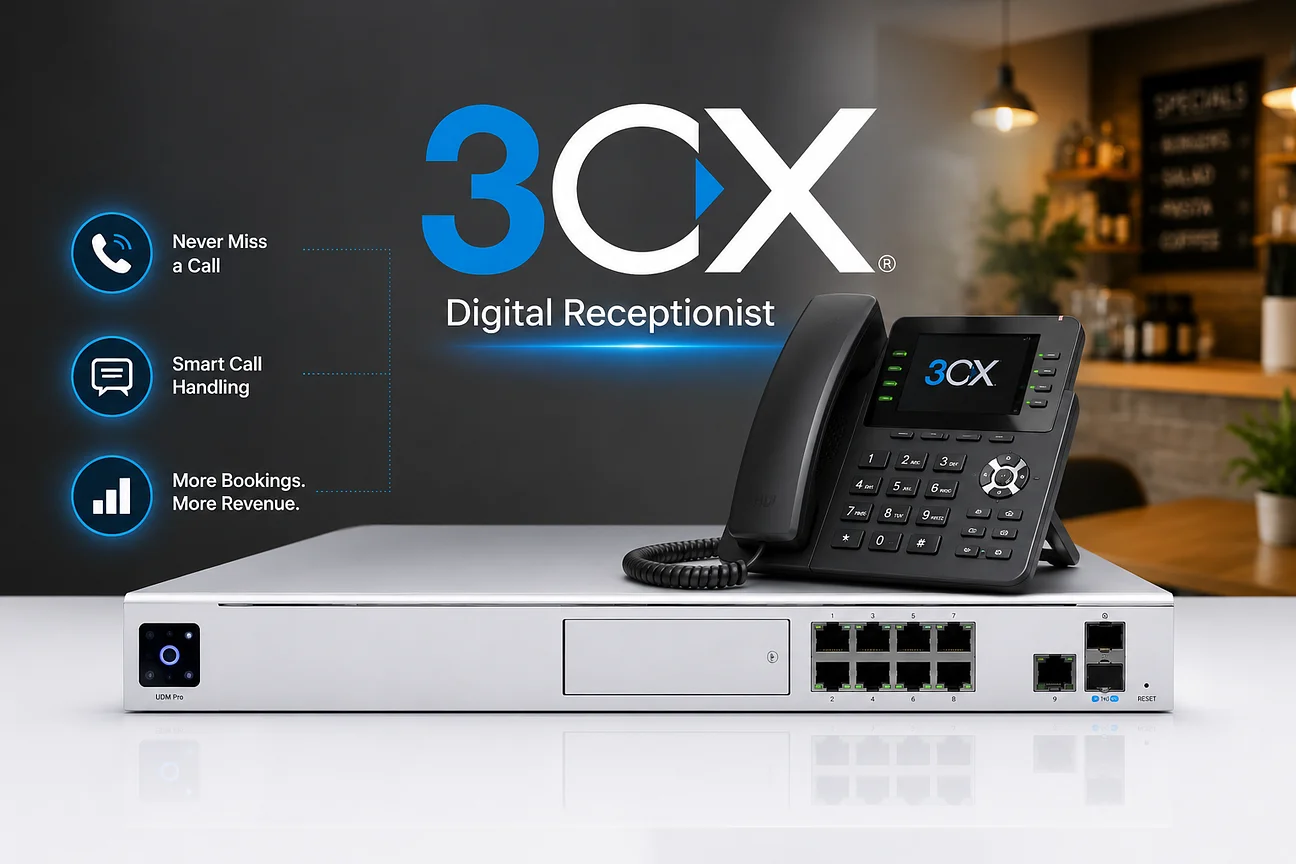
Most restaurants and retail stores answer every call manually — reservations, hours, directions, "is the kitchen still open?" A 3CX Digital Receptionist handles all of it without a person.
The Call Handling Problem
Every inbound call that requires a staff member to stop what they're doing has a cost.
For a restaurant during a dinner rush, that cost is real: interrupted service, slower order flow,
and customer experience friction. 3CX's Digital Receptionist (IVR) and AI Receptionist
automate the entire inbound call flow — routing, answering, and message-taking — 24/7.
30–40%
drop in missed calls after auto-attendant deployment (RingOffice, 200+ deployments)
Source: RingOffice 2026 deployment data
24/7
3CX AI Receptionist availability — answers calls, takes messages, and routes after hours without staff
Source: 3CX official documentation
<3yr
typical 3CX ROI — telephony cost reduced 20%+ vs. per-user UCaaS; hardware reuse possible
Source: 3CX case study, Douglas County School District
How 3CX Handles Calls
Three Levels of Call Automation — Each With a Different Use Case
Level 01
Digital Receptionist (IVR)
Multi-level menu system. Press 1 for reservations, 2 for hours, 3 for directions, 0 for the host. Configured once, runs indefinitely. Business hours and after-hours routing are separate configurations.
Always on
Level 02
AI Receptionist (OpenAI)
3CX V20 Update 8 (Oct 2025) introduced OpenAI-powered AI Receptionist. Callers speak naturally — no keypad required. AI collects details, routes calls, takes messages in multiple languages. Encrypted, configurable budget.
Natural language
Level 03
Call Queue + Ring Groups
When calls do need a human, ring groups distribute across available staff. Call queues manage peak volume with hold music and estimated wait time. No call goes unanswered during a rush.
Smart distribution
📞
What a Restaurant IVR Actually Handles
Hours and location (most called): recorded message, no staff needed. Reservation requests: routed to host stand or voicemail during peak. Takeout order status: routed to kitchen or POS display. Catering inquiries: routed to manager extension or voicemail with callback. After-hours emergency: routed to on-call via mobile. None of these require a staff member to answer a phone during service.
3CX Deployment at MKR
How MKR Systems Deploys 3CX for Restaurants and Retail
- ✓
Self-hosted on MKR Private Cloud — 3CX runs on your dedicated VM in our Proxmox infrastructure. No per-user SaaS fees. License cost is per simultaneous call, not per seat — significantly cheaper at scale.
- ✓
Flowroute SIP trunking — Your existing phone numbers port to Flowroute. Calls route through 3CX over your existing internet connection. No separate phone line billing.
- ✓
Digital Receptionist configured to your flow — We build your IVR menu, record or upload prompts, configure business/after-hours routing, and test every path before go-live.
- ✓
Mobile app for staff — 3CX mobile app on iOS/Android means staff can receive and make calls from the business number on their personal phones. No desk phone required for most roles.
- ✓
SMS-enabled DID — With a Flowroute SMS-capable DID, 3CX can receive and forward text messages — useful for reservation confirmations, order notifications, and customer callbacks.
MKR Systems Approach
We deploy 3CX with Flowroute SIP trunking on MKR Private Cloud — and configure the Digital Receptionist for your specific call flow.
Phone systems are operational infrastructure. A missed call during dinner service or a call going
to the wrong extension costs you — in customer experience and in staff time.
We design the call flow before we build it, test every path, and train your staff on the system.
📐 Mathematical Verification
3CX vs. Per-User UCaaS — Annual Cost Comparison (10-Person Business)
Per-user UCaaS (e.g., RingCentral, Nextiva): $25–$45/user/month × 10 users × 12 months = $3,000–$5,400/year3CX self-hosted on MKR Private Cloud: License + SIP trunking = $1,500–$2,500/year (priced by concurrent calls, not per seat — scales at no extra cost)Annual savings = $3,000–$5,400 minus $1,500–$2,500 = $500–$3,900/year= Savings range: 17–72% — varies by current UCaaS spend and call volume. Stated "20%+" is accurate as a floor for most deployments.
Source: RingOffice 2026 TCO analysis; 3CX official licensing page 2026
⚠ Corrected figure — see note
Full Receptionist Replacement Scenario — If Staff Reduction Is Achieved
Full-time receptionist cost (California 2026 minimum wage): $16.90/hr × 40 hrs/week × 52 weeks = $35,152/year + Payroll taxes & benefits (~20%) = $42,182/year total3CX Digital Receptionist cost: Included in license ($0 incremental)Net annual benefit = $42,182 − $2,500 (3CX annual cost)= $39,682/year — applies when the IVR fully handles inbound call volume that previously required a dedicated receptionist. Most restaurants use it to reduce interruptions during service, not eliminate headcount entirely.
Source: California Labor Code 2026 ($16.90/hr minimum); 3CX official licensing
✓ Verified
Every call your staff doesn't have to answer during service is time they spend serving customers.
A properly configured 3CX IVR with a Digital Receptionist handles hours, routing, and message-taking
automatically — at a fraction of the cost of a UCaaS per-user subscription.
Configure it once. It answers calls indefinitely.
References & Data Sources
- [1]3CX — Official Product Documentation — AI Receptionist (OpenAI integration) released in 3CX V20 Update 8, October 2025. www.3cx.com/blog/releases/v20-update-8/
- [2]3CX — Douglas County School District Case Study — Documented telephony cost reduction of 20%+ and <3-year ROI using 3CX self-hosted. www.3cx.com/case-studies/
- [3]RingOffice — Auto-Attendant ROI Report 2026 — 30–40% reduction in missed calls documented across 200+ 3CX deployments. ringoffice.com
- [4]Flowroute — SIP Trunking Documentation — SMS-capable DID, SIP trunk configuration, and carrier-grade reliability specifications. www.flowroute.com/documentation/
MKR Systems is an authorized Fiserv / Clover reseller and AT&T Business agent. All analysis, recommendations, and cost models in this article are independently produced by MKR Systems based on publicly available data and our direct operational experience. Third-party data sources are cited as listed above. MKR Systems is not affiliated with, endorsed by, or acting on behalf of Fiserv, Clover, Ubiquiti, 3CX, or any other vendor mentioned herein for the purposes of this publication.